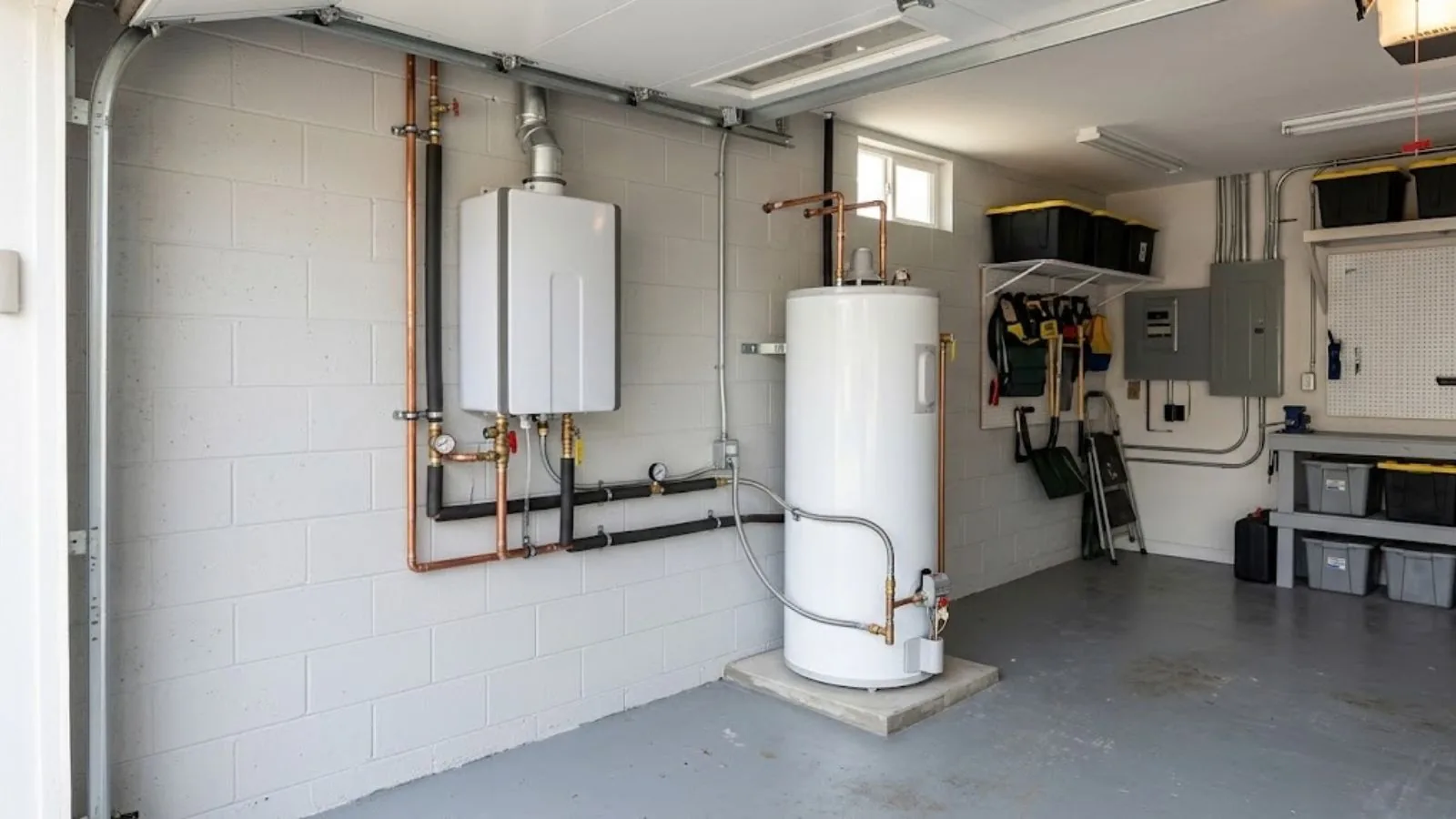
Whenever a water heater fails in San Marcos, the replacement conversation almost always includes the tankless question. Endless hot water is a genuinely appealing pitch, but the honest answer on whether it's right for your home depends partly on something specific to this region: hard water, and how differently it affects tank versus tankless systems.
How Tank Units Handle Hard Water
A standard tank water heater has a relatively large interior surface area, which means mineral scale from hard water has plenty of room to settle without immediately restricting anything. The tradeoff is that scale accumulates at the bottom of the tank over years, gradually reducing effective capacity and insulating the heating element, both of which contribute to the region's well-documented pattern of tank units failing before their rated lifespan.
Why Tankless Units Feel the Effect Faster
A tankless unit heats water on demand by passing it across a much smaller, more compact heat exchanger rather than storing it in a large tank. That smaller surface area means the same mineral content in the water concentrates its effect more noticeably, scale buildup on a tankless heat exchanger can restrict flow and trigger error codes meaningfully sooner than the equivalent scale buildup would visibly affect a tank unit. This isn't a flaw specific to any one brand of tankless unit; it's a function of the smaller, more efficient design being more sensitive to what's actually in the water passing through it.
What This Means in Practice
It doesn't mean tankless is a bad choice here, it means tankless units in this region benefit more from proactive maintenance, specifically annual descaling, than the same units would in a region with naturally soft water. A tankless unit that gets descaled on schedule can run reliably for its full expected lifespan; one that doesn't is more likely to show performance issues earlier than a tank unit in the same house would.
The Case for Pairing Either Option With Softening
Whichever type you choose, a water softener installed ahead of the unit meaningfully changes the math for both, removing the minerals before they ever reach the heat exchanger or tank interior extends service life either way, and for a tankless unit specifically, it reduces how often descaling maintenance is actually needed.
Making the Actual Decision
Beyond the hard-water question, the tankless-versus-tank decision still comes down to the usual factors: your household's simultaneous hot water demand, existing gas line and venting capacity if going tankless, and upfront cost versus long-term operating savings. If you're evaluating a straight water heater replacement and considering tankless for the first time, or you already have a tankless unit that seems to be struggling, getting the specific San Diego County hard-water factor into that conversation up front avoids a surprise a year or two down the line.
Neither option makes hard water disappear as a factor in your home's plumbing, but understanding how it affects each type differently means whichever you choose, you're choosing with a full picture rather than a generic national comparison that doesn't account for what's actually coming out of your tap.
Recovery Speed vs. Endless Hot Water
Beyond the hard water question, there's a genuine functional difference worth understanding regardless of which you choose. A tank unit stores a fixed volume of already-heated water, which means it can supply multiple fixtures simultaneously at full flow until that reserve runs out, then needs time to recover. A tankless unit doesn't have a reserve to run out, so in principle it offers continuous hot water, but its output is limited by flow rate rather than storage, meaning too many fixtures running at once can exceed what a given tankless unit can heat in real time. Sizing a tankless unit correctly for your household's actual peak simultaneous demand, not just average daily usage, is what determines whether it delivers on the "endless hot water" promise or disappoints the first time several fixtures run at once.
Installation Complexity Differs More Than People Expect
Swapping a tank unit for another tank unit is usually a same-day, relatively simple job in an existing water heater closet. Switching from tank to tankless for the first time is a bigger undertaking, often requiring larger gas line capacity, different venting materials rated for higher exhaust temperatures, and sometimes electrical work to support the unit's ignition system. This doesn't make tankless a bad choice, but it does mean the upfront cost comparison between the two options isn't just about the unit price itself.
Lifespan Expectations Worth Setting Realistically
Tankless units are often marketed with lifespan expectations well beyond a typical tank unit, sometimes 20 years or more under ideal conditions. That figure assumes proper maintenance, specifically the annual descaling this region's hard water makes more important than in most other markets. A tankless unit that never gets descaled won't come close to that upper-end lifespan figure, and comparing a well-maintained tankless unit's realistic lifespan against a similarly well-maintained tank unit's realistic lifespan, both with softening in place, is a fairer comparison than comparing best-case tankless marketing numbers against worst-case tank performance with no maintenance at all on either side.
Space Savings as an Underrated Factor
Beyond the hot water and hard water considerations, tankless units offer a genuinely practical advantage that sometimes gets overlooked in the efficiency-focused comparison: they're significantly smaller than a tank unit, which frees up meaningful closet or garage space in a home where that space matters. For a smaller San Marcos property where every storage closet counts, this space consideration is sometimes the deciding factor even before the hot water performance comparison enters the conversation, and it's worth mentioning to anyone weighing the decision purely on operating cost and hot water output alone.
Need a Plumber in San Marcos?
San Marcos Express Plumbing dispatches throughout San Marcos and the surrounding North County inland San Diego County area, 24/7 emergency dispatch.
Call (760) 986-1999