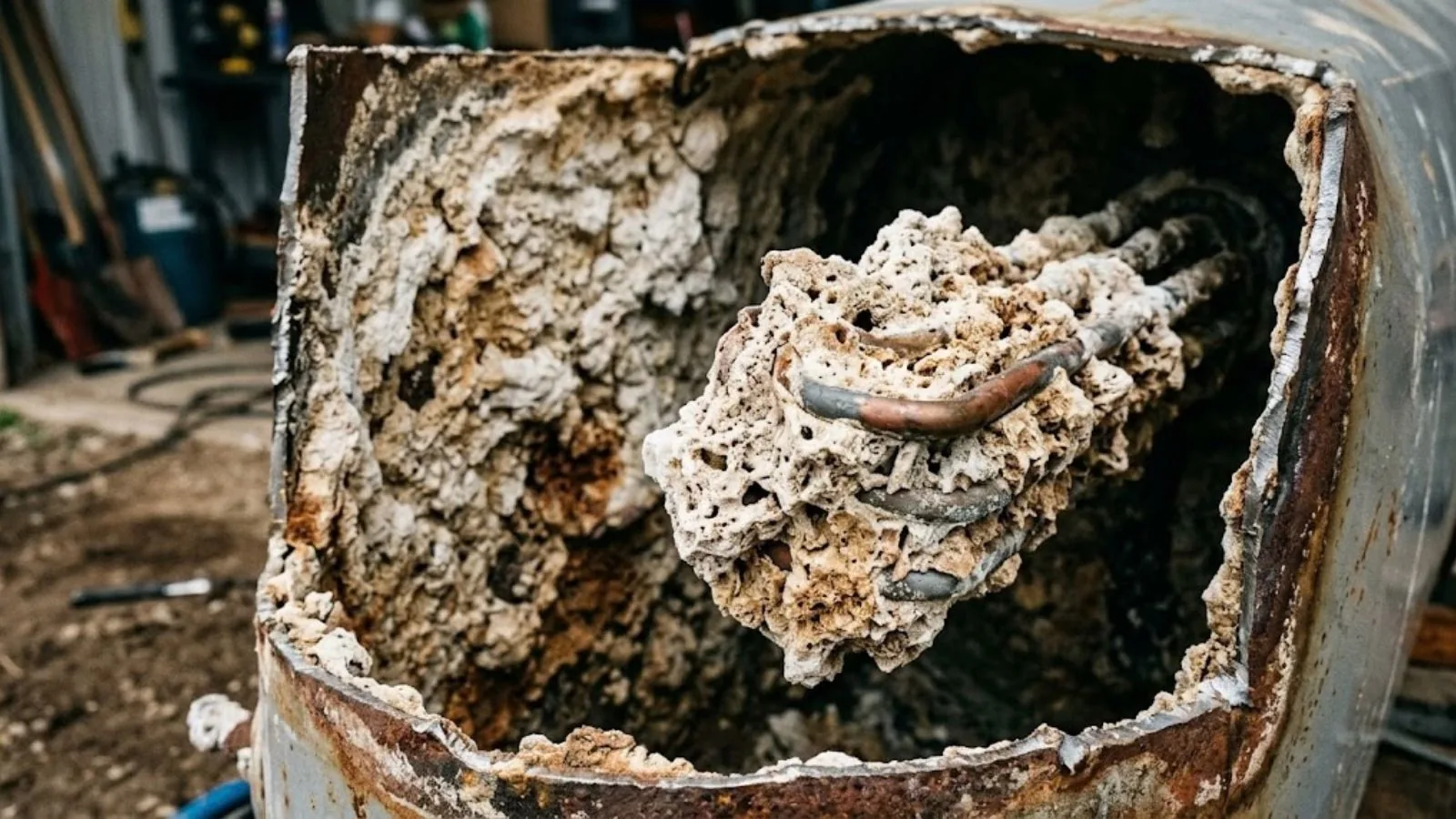
If you've replaced a water heater in San Marcos more than once in the last decade, you're not imagining it, homes in this part of San Diego County genuinely do go through water heaters faster than the manufacturer's rated lifespan would suggest. The reason isn't a bad batch of units or poor installation. It's the water itself.
Hard Water Is the Real Culprit
San Diego County's water supply carries a naturally high mineral content, mostly calcium and magnesium, which is what makes water "hard." Every time that water heats up inside a tank, some of those minerals precipitate out and settle as scale, a chalky buildup that coats the heating element and gradually accumulates at the bottom of the tank. Over months and years, that layer of sediment does two things: it insulates the heating element from the water it's supposed to be heating, forcing the unit to work harder and run longer for the same result, and it takes up physical space in the tank, reducing effective capacity.
How This Shows Up Day to Day
The early signs are subtle. Hot water that used to last through two showers back-to-back suddenly runs out after one. The tank starts making a rumbling or popping sound during heating cycles, that's actually water trapped under the sediment layer boiling and escaping through it, which is a reasonably reliable audible sign that scale buildup has become significant. Recovery time between uses gets longer. None of these show up as an emergency, which is exactly why they often get ignored until the unit fails outright, sometimes with an actual leak once the sediment layer has corroded a weak spot in the tank's lining.
Repair or Replace? It Depends on the Leak Location
Not every water heater problem means the whole unit is done. A leak at a fitting, valve, or the temperature-and-pressure relief valve is often a straightforward repair. A leak from the tank body itself, the actual steel shell, means the tank has failed internally and needs full replacement, since there's no reliable way to patch a corroded tank wall. If you're not sure which you're looking at, that's exactly the kind of thing worth having a plumber diagnose before assuming the worst.
What Actually Slows This Down
The most direct fix for the underlying cause, rather than the symptom, is addressing the water hardness itself. A water softener removes the minerals before they ever reach the tank, which meaningfully extends the service life of whatever water heater you have installed, new or old. It won't undo damage already done to an aging unit, but it changes the math for whatever gets installed next. If you're already looking at replacing a water heater that's failed early, pairing that replacement with softening is worth the conversation rather than just swapping in an identical unit that will likely face the same shortened lifespan.
A Reasonable Maintenance Habit
Flushing a water heater tank periodically to clear out accumulated sediment is a real maintenance step, though on an older tank it's worth some caution, sediment can sometimes be helping seal a small existing weak point, and disturbing it can occasionally reveal a leak that was masked rather than prevented. If your tank is more than a few years old and has never been flushed, that's worth a conversation with whoever services it rather than attempting it cold on a unit of unknown condition.
How Tank Age Should Shape Your Decision
Most manufacturers rate a standard tank water heater for 8 to 12 years of service under typical conditions. In San Marcos, given the hard water factor, it's reasonable to treat the lower end of that range as the more realistic expectation unless the household has already installed softening. If your unit is approaching or past that window and starting to show any of the early warning signs, that's a meaningfully different situation than a two-year-old unit showing the same symptoms. An older unit nearing its expected end of life is generally a better candidate for planned replacement than for another round of repair, since a repair on a unit that's already compromised by years of sediment buildup often just delays a second, more expensive failure by a matter of months rather than meaningfully extending its useful life.
Comparing This to How Other Regions Experience the Same Units
It's worth putting a number on this, even loosely: a water heater in a region with genuinely soft water can reasonably reach or exceed its full rated lifespan without any special intervention. In San Marcos and the surrounding San Diego County area, an identical unit with no softening upstream commonly shows meaningful performance decline well before that same age, sometimes by several years. This isn't a reflection of worse manufacturing or installation quality locally, it's a direct, measurable consequence of what's actually dissolved in the water passing through the tank day after day for years on end.
What a Professional Inspection Actually Checks
If you're not sure whether your water heater's symptoms point to a simple fix or a unit nearing the end of its service life, a professional inspection typically checks several things at once: the anode rod's condition (a sacrificial component that corrodes in place of the tank itself, and which fails faster in hard water), the amount of sediment actually present at the tank's base, the condition of the heating element or burner assembly, and whether any fittings show early signs of corrosion. Taken together, these give a much clearer picture than guessing from symptoms alone, and they're the same checks worth having done periodically even before anything seems obviously wrong, simply because catching sediment buildup early is meaningfully easier to address than catching it after a failure.
None of this means every San Marcos water heater is doomed to an early death. It means the regional water quality is a real, measurable factor in how long a tank lasts here compared to a region with naturally soft water, and treating it as such, through softening, sensible maintenance, and catching early warning signs, makes a meaningful difference over the life of the unit.
Need a Plumber in San Marcos?
San Marcos Express Plumbing dispatches throughout San Marcos and the surrounding North County inland San Diego County area, 24/7 emergency dispatch.
Call (760) 986-1999